
Aboveground Fuel Tanks: Types, Applications, and How to Choose the Right Tank
Aboveground fuel tanks are one of the solutions used to store fuel and other flammable or combustible liquids in projects where site conditions allow the tank to be installed above ground. Selecting the right tank depends on the type of liquid being stored, the nature of the project, operating requirements, site conditions, and the applicable project specifications and regulations.
Choosing a fuel tank does not begin with capacity alone. It starts with a complete understanding of the system in which the tank will operate, followed by determining the appropriate tank type, design, and configuration for the intended application.
What Are Aboveground Fuel Tanks?
Aboveground fuel tanks are stationary tanks installed above ground level to store fuel or other liquids for applications permitted by the tank design, the applicable standard, and site requirements.
Aboveground installation provides direct access to the tank and its components, which can make inspection, monitoring, and maintenance easier than with buried tanks. However, safety, installation, venting, protection, and containment requirements still depend on the tank type, the liquid being stored, and site conditions.
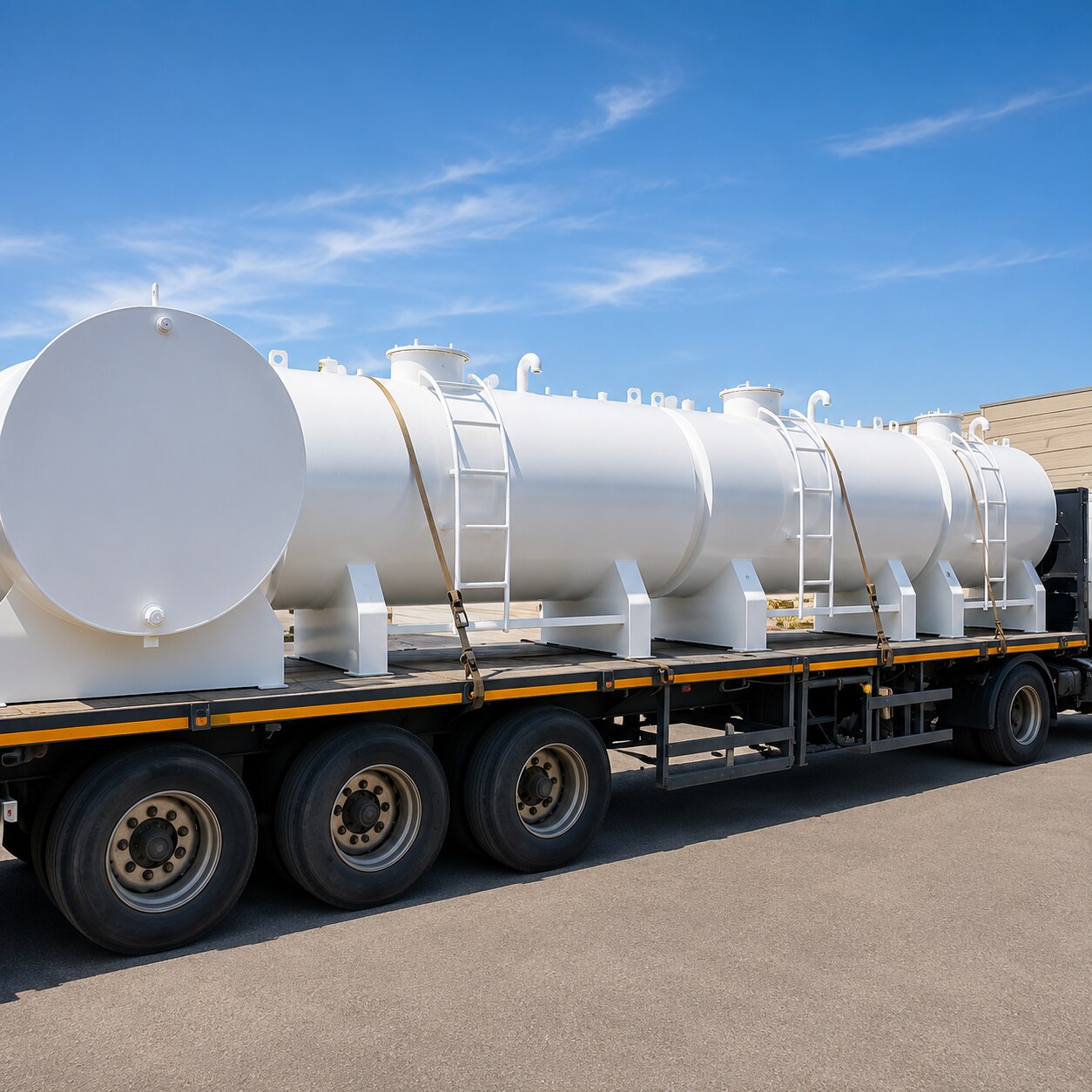
UL Solutions explains that UL 142 covers steel aboveground tanks intended for storing flammable and combustible liquids. The standard includes primary tanks, secondary-containment tanks, and diked-type tanks in a variety of configurations and shapes, including horizontal, vertical, cylindrical, and rectangular designs.
What Types of Aboveground Fuel Tanks Are Available?
There is no single aboveground fuel-tank type suitable for every project. Tank design and configuration vary according to the application and the project's storage and operating requirements.
1. Single-Wall Tanks
A single-wall tank consists of one storage shell containing the stored liquid. It is used when this configuration is suitable for the nature of the project, site requirements, and applicable regulations.
A single-wall tank should not be selected solely because of its lower initial cost. The correct decision must be based on a risk assessment, project requirements, and the required containment system.
2. Double-Wall Tanks
A double-wall tank consists of a primary tank and an interstitial space that provides additional containment. Depending on the tank design and certification scope, the interstitial space may incorporate leak-monitoring provisions.
UL Solutions indicates that UL 142 tanks may include secondary-containment configurations, with requirements relating to interstitial-space monitoring where secondary containment is provided.
For this reason, selecting a double-wall tank should not be treated as a marketing decision. It is an engineering decision connected to project requirements and the required level of protection.
3. Horizontal and Vertical Tanks
UL 142 tanks may be produced in different configurations, including cylindrical or rectangular and horizontal or vertical designs, depending on the application and approved design.
The selected configuration affects space utilization, installation methods, accessibility, and project requirements. It should therefore be determined as part of the engineering design rather than separately from actual site conditions.
Where Are Aboveground Fuel Tanks Used?
Aboveground fuel tanks are used across a wide range of applications requiring the stationary storage of fuel or other liquids compatible with the tank design.
Projects that may use this type of solution include:
Industrial facilities
Factories
Energy projects
Commercial facilities and utilities
Certain fuel-station applications
Infrastructure projects
Applications requiring fuel storage close to operating equipment or systems
However, installing a tank above ground does not automatically make it the best solution for every project. Site conditions, the type of liquid, operating requirements, protection requirements, available space, and local regulations must all be considered in the decision.
Why Do Some Projects Choose Aboveground Tanks?
An aboveground tank provides direct access to the tank shell and its components, supporting inspection, monitoring, and maintenance activities.
Aboveground installation may also provide greater accessibility to filling, suction, measurement, venting, and other tank-related components, depending on the tank design and configuration.
UL Solutions notes that UL 142 tanks may include, within the scope of their certification, filling, withdrawal, gauging, and monitoring openings, along with normal and emergency vents and certain integral accessories, depending on the tank type and configuration.
Nevertheless, accessibility does not eliminate the need for regular inspection. Tank integrity depends on correct design, proper installation, and an inspection and maintenance program appropriate to the facility. As one example from the United States, EPA guidance emphasizes the importance of periodically inspecting aboveground storage tanks in accordance with relevant industry standards.
How Does UL 142 Relate to Aboveground Fuel Tanks?
UL 142 is a standard for steel aboveground tanks intended for flammable and combustible liquids within the scope of the standard.
It establishes requirements relating to the design and manufacture of tanks covered by its scope. These include different configurations, such as primary tanks, secondary-containment tanks, and diked-type tanks, depending on the product type and design.
It is important to understand that the UL Mark does not mean every component in the overall project system is automatically covered by the same certification. UL Solutions explains that the Listing applies to the tank and the features included within its certification scope. Other components or additions may require separate evaluation or certification according to project requirements and the authority having jurisdiction.
This is an important point when comparing suppliers. It is not enough to ask, “Is the tank UL Listed?” You should also ask: Which standard applies? What type of Listing does it have? What exactly does that Listing cover?
How Do I Know Which Aboveground Fuel Tank Is Right for My Project?
Selecting the right fuel tank does not depend on capacity alone.
Five main factors should be evaluated before choosing a solution.
First: Installation Type
Is the tank intended for aboveground or underground installation?
This decision determines the applicable design path and standard. UL 142 tanks are intended for aboveground applications within the standard's scope, while UL 58 applies to underground steel tanks.
Second: Type of Stored Liquid
The liquid to be stored must be identified because its properties and compatibility with the tank's materials and design affect solution selection.
It is incorrect to assume that any fuel tank is suitable for any liquid simply because the required capacity is similar.
Third: Operating Environment
Will the tank be exposed to weather conditions? Is the available space limited? Are there nearby heat sources or operating hazards? Are there specific containment or protection requirements?
Answering these questions helps determine the appropriate tank configuration and related options.
Fourth: Operating Requirements
The way the tank will be used must be clearly defined, including filling, withdrawal, measurement, monitoring, venting, connection to pumping equipment or fuel systems, and any other operational requirements.
All these elements should be considered during the design stage rather than added later as separate components.
Fifth: Regulatory Requirements
The codes, standards, and regulations applicable to the project and its location must be identified before the final design is approved.
UL Solutions emphasizes that UL 142 tanks must be installed in accordance with the codes and requirements applicable at the site. Certification of the tank itself does not eliminate project-specific installation requirements.
Is a Larger Tank Always the Better Choice?
Not necessarily.
The right tank is one whose capacity, configuration, and design match the project's actual needs—not simply the largest or least expensive option.
Choosing more capacity than required may result in unnecessary cost and inefficient use of space. Selecting less capacity than the project needs may create operational limitations or require future modifications.
Capacity should therefore be determined according to consumption patterns, operating conditions, required storage duration, and project requirements—not price alone.
What Is the Difference Between Selecting a Tank and Selecting a Storage System?
The tank is a fundamental part of the storage system, but it is not the entire system.
A project may require an interconnected set of components, including the tank, filling and withdrawal points, measurement and monitoring equipment, venting, piping, control components, and other elements that vary according to the application.
Selecting the tank without considering the rest of the system may result in a solution that does not fully meet operational requirements.
At the Arabian Pumps and Mechanical Industries Factory (APMI), the process begins with understanding the project's requirements and then developing the appropriate engineering and manufacturing solution. The tank can also be integrated with fuel systems and piping according to the project scope.
Frequently Asked Questions About Aboveground Fuel Tanks
Are All Aboveground Fuel Tanks Covered by UL 142?
No. UL 142 is one of the standards used for steel aboveground tanks intended for flammable and combustible liquids. Other standards apply to different applications and configurations. The applicable standard must therefore be selected according to the tank type, liquid, and intended application.
Is a Double-Wall Tank Always Better Than a Single-Wall Tank?
It is not accurate to consider one type better for every project. The choice depends on project requirements, the required level of containment, site conditions, and applicable regulatory and operating requirements.
Can a UL 142 Tank Be Installed Underground?
UL Solutions explains that UL 142 tanks are not evaluated for underground installation. They may, however, be suitable for installation within below-grade vaults Listed to UL 2245 where applicable installation requirements permit. UL 142 and UL 58 should therefore not be treated as interchangeable standards.
What Is the Most Important Information to Have Before Ordering a Fuel Tank?
Start by identifying the type of liquid, tank installation location, intended use, required capacity, site conditions, operating requirements, and compliance obligations. This information helps determine the appropriate tank and configuration instead of selecting a product based only on price or capacity.
Conclusion
Aboveground fuel tanks are more than tanks placed above ground. Selecting the right tank is an engineering decision connected to the type of liquid, the nature of the project, site conditions, operating requirements, and applicable standards and regulations.
When these factors are clearly defined, selecting the tank type, configuration, and applicable standard becomes more accurate, and the storage system becomes an integrated part of the project's engineering solution.